Introduction
The accelerating impacts of climate change have elevated greenhouse gas (GHG) mitigation to the forefront of global economic and policy agendas. Enterprises and governments worldwide are increasingly recognising the urgency of reducing emissions and integrating climate considerations into trade, investment, and industrial strategy. As climate risks intensify, regulatory frameworks and market-based instruments are evolving to facilitate the transition toward a low-carbon economy.
The European Union (EU) has adopted a comprehensive climate policy framework aimed at achieving its legally binding target of reducing greenhouse gas emissions by at least 55% by 2030. To support this objective, the EU has introduced regulatory measures that integrate carbon pricing into both domestic production and international trade.
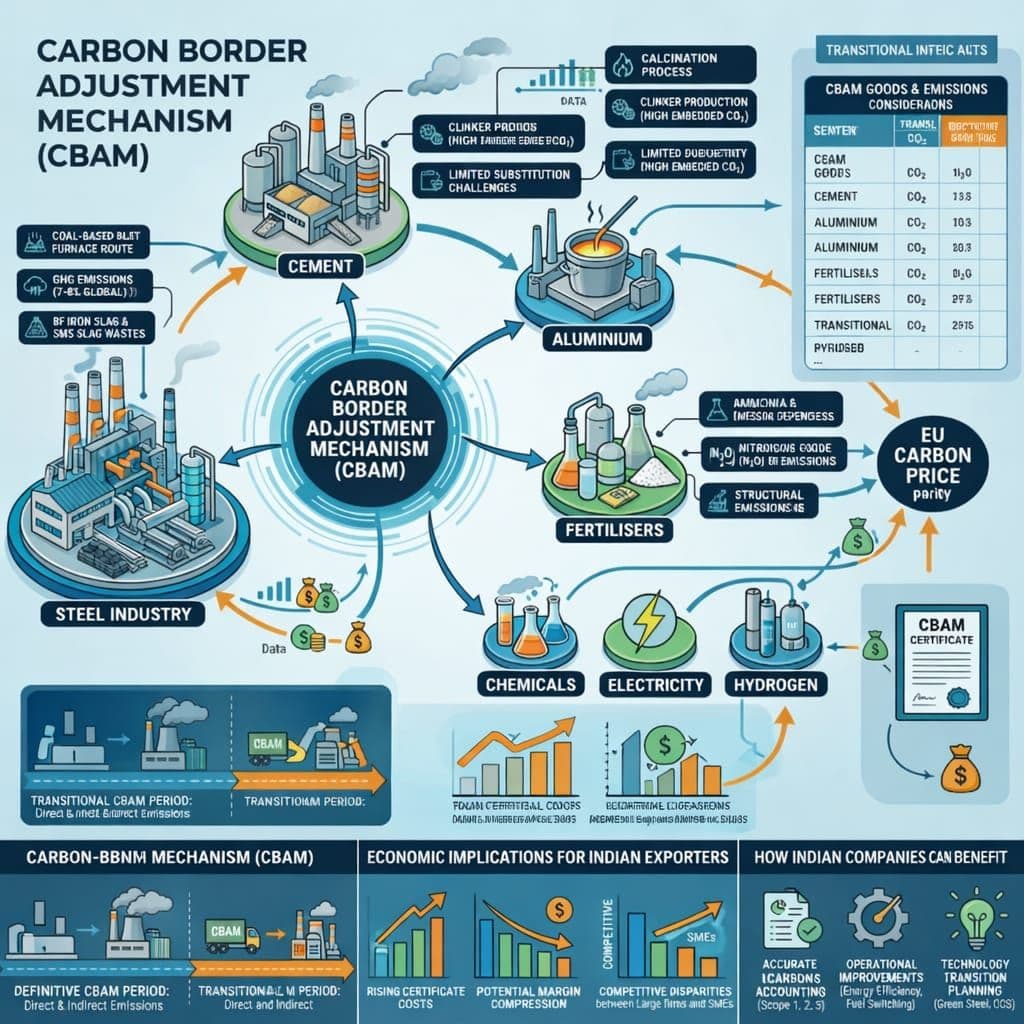
One of the most significant of these measures is the Carbon Border Adjustment Mechanism (CBAM). CBAM is designed to complement and align with the EU Emissions Trading System (ETS), ensuring that imported goods are subject to a carbon cost equivalent to that borne by EU producers. The mechanism seeks to address the risk of carbon leakage — the relocation of production to jurisdictions with less stringent climate policies.
Under CBAM, importers are required to account for the embedded emissions associated with the production of goods entering the EU market and to purchase CBAM certificates corresponding to those emissions. The price of these certificates is linked to the prevailing carbon price under the EU ETS, ensuring consistency and competitive neutrality between EU and non-EU producers.
Through this framework, CBAM integrates carbon pricing into cross-border trade while reinforcing the EU’s broader climate objectives and creating incentives for global producers to enhance emissions transparency and reduce carbon intensity.
Objectives
The Carbon Border Adjustment Mechanism (CBAM) is designed as a trade-linked climate instrument to operationalise carbon pricing at the EU’s external border. Its objective is not merely to acknowledge carbon leakage as a risk, but to structurally integrate carbon cost equivalence into cross-border trade.
At its core, CBAM seeks to align the carbon cost of imported goods with the cost borne by EU producers under the EU Emissions Trading System (ETS).
Key objectives of CBAM include:
- Ensuring carbon price parity between EU-produced goods and imported goods
- Protecting the integrity of the EU ETS by preventing relocation of production
- Embedding carbon accountability into international supply chains
- Providing a transparent and rules-based framework for assessing embedded emissions in traded goods
- Creating long-term decarbonisation incentives for producers supplying the EU market
Emissions Considered by EU for CBAM
Direct Emissions
Direct emissions are calculated using the following approach:
Activity Data × Emission Factor = Tonnes of Emissions
Tonnes of Emissions × Global Warming Potential = Carbon Dioxide Equivalent (CO₂e)
Indirect Emissions
Indirect emissions refer to emissions associated with electricity consumption.
Scope 2 Emissions are calculated as:
Activity Data (MWh) × Emission Factor = Indirect Emissions
Greenhouse Gas Coverage by CBAM Sector
Different CBAM sectors include different greenhouse gases:
Cement
- Only carbon dioxide (CO₂) emissions are considered.
Fertilisers
- Carbon dioxide (CO₂)
- Nitrous oxide (N₂O) for certain fertiliser products.
Iron and Steel
- Only carbon dioxide (CO₂).
Aluminium
- Carbon dioxide (CO₂)
- Perfluorocarbons (PFCs) for certain aluminium goods.
Hydrogen
- Only carbon dioxide (CO₂).
Electricity
- Only carbon dioxide (CO₂).
All emissions are reported in tonnes of carbon dioxide equivalent (tCO₂e).
CBAM Goods Covered
Iron and Steel Products
Examples of covered iron and steel goods include:
- Sheet piling (HS 7301)
- Railway materials (HS 7302)
- Tubes of cast iron (HS 730300)
- Tubes other than cast iron (HS 7304)
- Other tubes (HS 7305)
- Hollow profiles (HS 7306)
- Tube fittings (HS 7307)
- Steel structures (HS 7308)
- Reservoirs and containers (HS 7309)
Aluminium Products
Covered aluminium goods include:
- Unwrought aluminium (HS 7601)
- Aluminium powders (HS 7603)
- Aluminium bars (HS 7604)
- Aluminium wire (HS 7605)
- Aluminium plates and sheets (HS 7606)
Chemicals
- Hydrogen (HS 28041000)
Electricity
- Electrical energy (HS 27160000)
Fertilisers
- Nitric acid (HS 28080000)
- Ammonia (HS 28141000 / 28142000)
- Potassium nitrates (HS 28342100)
Cement
- Clinkers (HS 25231000)
- Kaolin and other kaolinic clays (HS 25070080)
- White Portland cement (HS 25232100)
- Other Portland cement (HS 25232900)
Steel Industry Emissions Context
The steel industry is one of the most carbon-intensive sectors globally. According to the International Energy Agency (IEA), the iron and steel sector accounts for approximately 7–8% of global energy-related CO₂ emissions.
In India, the sector contributes roughly 2% to GDP while also representing a major source of industrial emissions. Estimates from the Institute for Energy Economics and Financial Analysis (IEEFA) indicate that India’s steel industry emits nearly 240 million tonnes of CO₂ annually, accounting for roughly 10–12% of the country’s total emissions.
This relatively high emissions intensity is largely driven by coal-based blast furnace production routes, which dominate Indian steel manufacturing.
Integrated steel plants also produce significant industrial by-products and wastes, including:
- Blast furnace (BF) iron slag
- Steel melting shop (SMS) slag
These wastes together account for more than half a tonne per tonne of steel produced in integrated steel plants.
Why CBAM Matters for India
Global trade is undergoing a structural shift. Climate policy is no longer confined to domestic environmental regulation — it is increasingly shaping international commerce.
Through its “Fit for 55” policy package, the European Union has strengthened its commitment to reducing greenhouse gas emissions by at least 55% by 2030.
CBAM represents a cross-border carbon pricing measure that aligns the carbon cost of imported goods with that faced by EU producers under the EU Emissions Trading System.
For exporting nations such as India — particularly in sectors like steel, aluminium, cement, fertilisers, and hydrogen — CBAM represents a structural shift in global trade economics. Carbon intensity is becoming a key determinant of market access and price competitiveness.
India is among the world’s largest producers of several CBAM-covered goods, and the European Union remains an important export destination for finished steel and value-added products.
Indian CBAM Goods Export to EU
India’s exports of finished steel to the EU have increased significantly over recent years.
- In 2019–20, exports were approximately 1.95 million tonnes, valued at around ₹10,692 crore.
- In 2020–21, exports rose to 2.51 million tonnes, valued at ₹14,144 crore.
- In 2021–22, exports reached 3.58 million tonnes, valued at ₹32,149 crore.
- In 2022–23, exports were approximately 2.49 million tonnes, valued at ₹22,482 crore.
- In 2023–24, exports increased again to 4.03 million tonnes, valued at roughly ₹29,534 crore.
India also exports aluminium to several European countries including Italy, Greece, and the Netherlands, with exports fluctuating significantly between 2020 and 2024 depending on global commodity prices and demand.
Economic Implications of CBAM for Indian Exporters
Exporters supplying CBAM-covered goods to the European Union will indirectly bear the cost of purchasing CBAM certificates corresponding to the embedded emissions in their products. Although the formal obligation lies with EU importers, these carbon costs are likely to be passed back through pricing negotiations.
This introduces an additional cost layer that may compress profit margins and weaken price competitiveness, particularly in carbon-intensive sectors.
The impact will not be uniform across industries. Sectors such as steel are particularly vulnerable due to their relatively high emission intensity, significant export exposure to the EU, and capital-intensive production systems.
Within the Indian steel industry, the impact is also likely to be uneven. Large integrated producers with stronger balance sheets and better compliance capabilities will be better positioned to invest in emissions monitoring systems and cleaner technologies. In contrast, small and medium enterprises (SMEs) may face greater adjustment challenges.
What This Means for Indian Steel Exporters
Finished steel exports to the European Union exceeded 4 million tonnes in 2023–24, underscoring the strategic importance of the EU market.
However, under CBAM, export competitiveness will increasingly depend not only on price and quality, but also on verified carbon intensity.
Major Indian exporters such as Tata Steel, JSW Steel, and Jindal Stainless have significant exposure to EU markets across various product categories.
Given India’s continued reliance on coal-based blast furnace routes, sectoral carbon intensity remains structurally higher than that of electric arc furnace-based producers in Europe.
Without accelerated investments in green steel technologies, scrap-based production, and renewable energy integration, Indian exporters may face increasing carbon cost adjustments under CBAM.
Aluminium: Electricity as the Primary Cost Driver
Aluminium production is one of the most electricity-intensive industrial processes globally. In India, the carbon intensity of aluminium is closely linked to the grid emission factor, as the sector still depends heavily on coal-based power generation.
Under CBAM, both direct process emissions and high-global-warming-potential gases such as perfluorocarbons (PFCs) must be reported.
Major Indian exporters include:
- Hindalco Industries
- Vedanta Aluminium
- National Aluminium Company
Because a large portion of smelting power comes from coal-based electricity, Scope 2 emissions significantly increase the embedded carbon intensity of Indian aluminium exports.
Improving competitiveness will require greater adoption of renewable power sourcing, green power purchase agreements, and increased recycled aluminium production.
Fertilisers: Process Emissions as a Structural Constraint
The fertiliser sector — particularly ammonia and nitric acid production — is inherently emissions-intensive due to process-related greenhouse gases.
Nitrous oxide (N₂O), which has a very high global warming potential, is a significant contributor in nitric acid production.
Major Indian producers include:
- Rashtriya Chemicals & Fertilizers
- Chambal Fertilisers & Chemicals
- National Fertilizers Limited
Future competitiveness will depend on N₂O abatement technologies, energy-efficient reforming processes, and the gradual development of green ammonia pathways.
Cement: Calcination and Limited Substitution
Cement production presents a unique decarbonisation challenge because a large portion of emissions arise from calcination — the chemical conversion of limestone into clinker.
These process emissions cannot be eliminated simply through renewable energy substitution.
Major Indian producers include:
- UltraTech Cement
- Shree Cement
- Dalmia Bharat
Reducing carbon intensity will depend on increasing blended cement ratios, expanding alternative fuel use, and investing in carbon capture technologies.
How Indian Export Companies Can Benefit from Working with Ploxi
As carbon regulations such as CBAM reshape global trade, Indian manufacturers must strengthen both emissions transparency and operational efficiency.
Ploxi supports companies through:
- Comprehensive emissions calculations covering Scope 1, Scope 2, and Scope 3 emissions
- Establishing Monitoring, Reporting, and Verification (MRV) systems
- Preparing companies for third-party audits and compliance checks
Beyond regulatory alignment, Ploxi also helps manufacturers improve operational performance through:
- energy efficiency improvements
- fuel switching strategies
- process innovation
- long-term decarbonisation planning
Through this integrated approach, companies can not only comply with CBAM requirements but also improve cost efficiency, market access, and competitiveness in an increasingly carbon-regulated global market.