India's climate ambitions are reflected through the Nationally Determined Contributions (NDCs) and the announcement of Net Zero emissions by 2070. For financing India's ambitious climate action, the Indian Government launched a draft climate taxonomy to encourage investment into green technologies and help the country cut carbon emissions.
Let's begin by understanding the term climate/green taxonomy
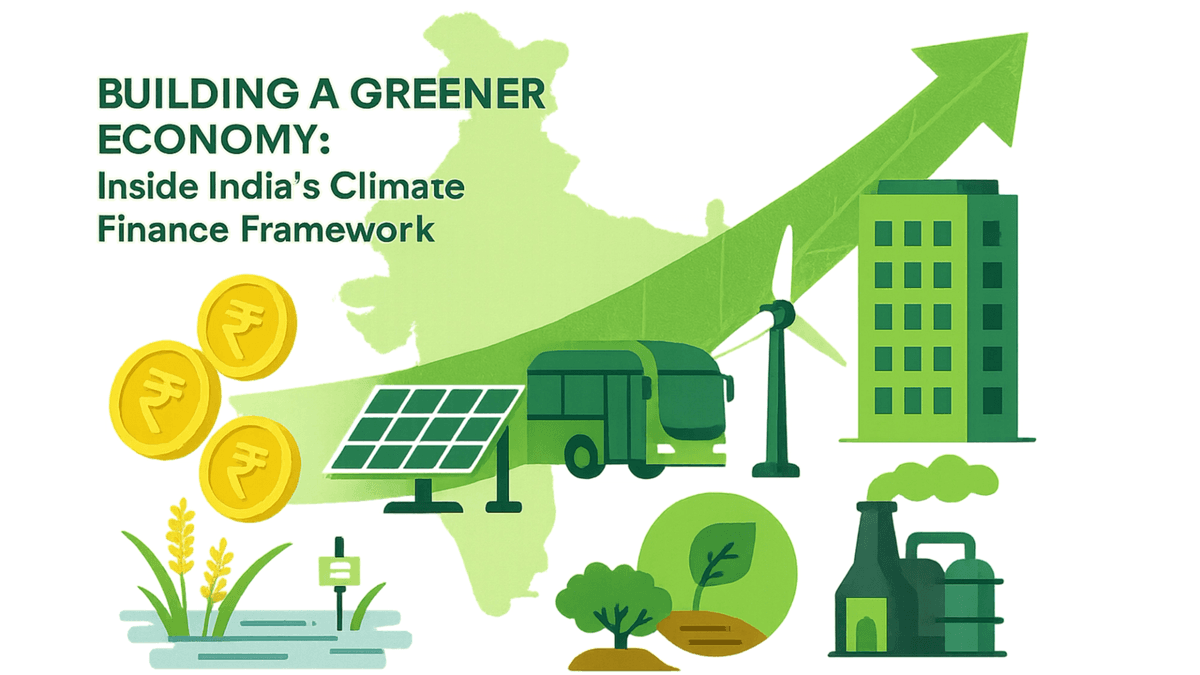
Exploring India's Climate Finance Framework: Initiatives in renewable energy, sustainable agriculture, and green infrastructure aim to build a greener economy.
A taxonomy in green and sustainable finance is a classification system that helps identify and classify investments as green based on their alignment with specific environmental objectives & targets. Green taxonomies can cover a wide range of objectives, such as climate mitigation, adaptation, water, circular economy, pollution and biodiversity.
Since the European Union introduced its landmark Taxonomy Regulations in 2020, the Global landscape for sustainable finance standards has rapidly expanded. India became the latest entrant, releasing a climate taxonomy draft on May 2025.
How India's Taxonomy Aligns with Global Standards
Recognizing the role of green taxonomy in mobilizing climate finance, countries worldwide rapidly adopted these frameworks. China was the first to introduce green taxonomy in 2015. The European Union (EU) adopted its Taxonomy Regulation in 2020. Since then, Singapore, Mexico, South Africa, Colombia, South Korea, Thailand and others followed suit.
As the global urgency around climate finance intensifies, countries are increasingly drawing lessons from one another to shape their own sustainable finance frameworks. The European Union’s taxonomy has emerged as a benchmark, with its core principles gaining widespread recognition. These include:
making a substantial positive contribution to climate or environmental goals,
ensuring no significant harm to other sustainability priorities, and
adhering to minimum social and governance safeguards.
These foundational elements are now influencing taxonomies worldwide, including India’s. Moreover, modern taxonomies are evolving to include screening mechanisms that accommodate transitional activities—particularly in hard-to-abate sectors like steel and cement. While fully green alternatives may not yet exist for these industries, such frameworks allow for their decarbonization pathways to be recognized, enabling them to progressively align with net-zero targets.
India's Draft Climate Finance Taxonomy: What it covers...
India’s transition to a low-carbon economy will require an estimated $2.5 trillion by 2030, according to the Council on Energy, Environment and Water (CEEW). That translates to an annual requirement of around $170 billion, as per the Climate Policy Initiative (CPI).
India's climate finance taxonomy aims to facilitate greater resource flow to climate friendly technologies and activities, enabling the country to achieve the vision of being net zero by 2070 while also ensuring long term access to reliable and affordable energy. The taxonomy should also prevent 'greenwashing'.
The approach will be conducted into two distinct phases: The first phase will establish the foundational framework and the approach. Following this, the second phase will involve the classification of activities, measures, and projects that are climate supportive, along with those facilitating transition in specific sectors & industries.
The major objective of the taxonomy is to facilitate greater resource flow to climate friendly technologies and activities, enabling achievement of the country's vision to be Net Zero by 2070 while ensuring long term access to reliable and affordable energy.
The draft highlights to cover technologies, measures, projects and activities that are aligned to:
- Mitigation: Includes improvements in energy efficiency or reduction in emission intensity.
- Adaptation: Action that enhances resilience
- Support transition of hard-to-abate sectors
The sectors identified under the draft framework are
- Power, Mobility, and Buildings
- Agriculture, food and water security
- Hard-to-abate sectors like Iron, Steel & Cement
The principles that form the basis of the framework are:
Consistency with stated position on Climate Action and development priorities: NDCs and the announcement of Net Zero carbon emissions by 2070 should be consistent with other climate finance framework
Do no significant harm to other objectives of the climate finance taxonomy: Implementation of measures & projects that prevent or minimize adverse effects on other climate objectives.
Focusing on pathways and trajectories in the country context: The taxonomy should contribute to a reduction in carbon emission intensity or long term carbon pathways recognizing that immediate compliance with stringent standards may not be feasible in the short term
Interoperability and consistency: Indian taxonomy for climate finance will reflect and allow flexibility considering the country's context, development priorities, and national climate goals.
Support Transition Activities: Taxonomy should facilitate a dynamic & inclusive classification system that recognizes & supports sectors crucial for transition.
Promote the use of indigenous technologies: Taxonomy should strive to enhance investments in Indigenous technologies by incentivizing the adoption of technologies.
Be science based and transparent: The approach should be objective, supported by clearly defined and disclosed metrics, and should rely on transparent and robust methodologies to identify investment opportunities.
Proportionality - Support for MSMEs: The taxonomy will include simplified and proportionate criteria for MSMEs to facilitate their inclusion in the climate finance framework, addressing their resource constraints and ensuring their smooth transition to low-carbon pathways.
Paving the Path to a Sustainable Future
India’s draft climate finance taxonomy marks a pivotal moment in the country’s journey towards a sustainable and low-carbon future. By aligning with global standards while tailoring the framework to India’s unique developmental context, the taxonomy aims to unlock significant climate finance, accelerate clean technology adoption, and ensure a just transition across sectors. Its focus on transparency, science-based classification, indigenous innovation, and support for MSMEs positions India not just as a participant, but a leader in shaping the future of green finance.
As the world races against time to meet climate targets, a robust, inclusive, and adaptable taxonomy will be key to bridging the financing gap. With the right implementation and stakeholder engagement, India’s green taxonomy can become a powerful tool—not just for reducing emissions, but for building climate-resilient communities, empowering industries, and charting a pathway to a net-zero economy by 2070. The next step is not just policy — but purposeful action.